I'm a Veterinarian and I Couldn't Fix My Own Dog's Worst Behaviors. Then a Neuroscientist Showed Me This.
📅 Wed. February 12, 2026 | 8:14 AM EST
👁 147,832 views
Written by Dr. Jessica Clarke, DVM, Veterinary Behaviorist
A licensed veterinarian reveals why obedience classes, "alpha" training, and anxiety meds never fix the real problem... and the simple 20-minute method that's replacing $200/hour behaviorists across the country.
I need to tell you something embarrassing.
I have a veterinary degree hanging on my wall, twelve years of clinical experience, and a specialty in canine behavioral medicine.
And for two straight years, my own dog was a complete disaster.
Lucy, my golden retriever, my best girl, the dog I adopted because I thought I'd be the perfect dog mom... she was out of control in ways I couldn't explain, let alone fix.
I'm not talking about a little whining when I left the house.
I'm talking about:
- Lunging and barking at every dog, person, bicycle, and leaf on our walks
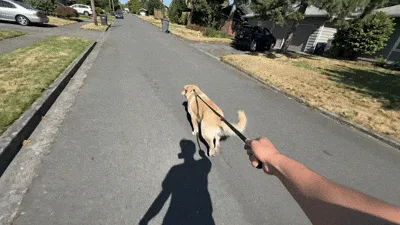
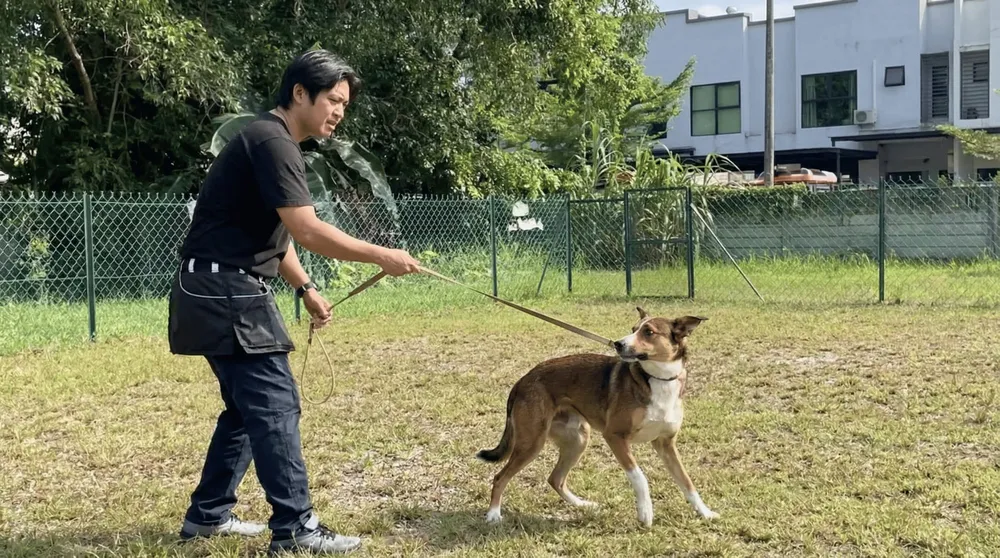
- Pulling so hard on the leash I had bruises on my hands
- Destroying furniture, shoes, and door frames when left alone (even for 20 minutes)
- Completely ignoring commands she clearly knew, like her brain just... couldn't process them
- Neighbors complaining about non-stop barking
- Bouncing off the walls with uncontrollable energy, then crashing into anxious panting
- Shaking through every thunderstorm like the world was ending
The worst part?
I was the person other dog owners came to for help.
I'd sit in my exam room, confidently recommending behavior protocols to my clients, then come home to a dog who'd shredded another couch cushion and couldn't walk down the street without losing her mind.
The guilt was unbearable.
If I couldn't help my own dog, with all my training, all my resources, all my knowledge... what hope did anyone have?
If you've ever felt that knot in your stomach when you come home wondering "what did she destroy today?"
Or that hot flush of shame when your dog lunges at another dog and every person in the park stares at you...
Or that helpless frustration when you know your dog is smart, but she won't listen to a single thing you say...
I promise you. I've been exactly where you are.
And what I discovered changed everything. Not just for Lucy, but for over 18,000 dog owners who've used this method since.
Give me the next 7 minutes and I'll show you exactly what happened.
The $2,150 Mistake That Made Everything Worse
Before I found the answer, I did what any desperate dog mom would do.
I threw money at the problem.
First, I tried the highest-rated trainer in my area. $150 per session, twice a week, two hours of driving each time.
After ten weeks and $2,150, here's what I got:
A dog who had learned to fear the trainer's corrections. But whose pulling, barking, destruction, and disobedience were actually worse than before we started.
His approach? "You need to be more dominant." "Make her respect you." "Show her who's alpha."
I could see it in Lucy's eyes. She wasn't being "defiant." She was overwhelmed and couldn't help herself.
Then I tried medications. Fluoxetine. Trazodone. Clomipramine.
Lucy walked around like a zombie. Glassy eyes. No energy. She stopped destroying things, but she also stopped being Lucy.
I tried the anxiety vests. The CBD treats. The pheromone diffusers. The YouTube "calming music" playlists.
Nothing worked. Or if it worked, it only lasted an hour.
I started googling "rehoming a difficult dog."
I never clicked on it. But the fact that I even typed those words... I still get a lump in my throat thinking about it.
That was my rock bottom.
★★★★★
"I spent $3,400 on trainers and my Lab was still a wreck. Pulling on every walk, barking at everything, destroying things when I left. I was crying in my car after every walk. If you're at that point... just keep reading. I wish I'd found this two years ago."
Rachel M., Labrador mom, Austin, TX
✓ Verified Buyer
The 2 AM Research Rabbit Hole That Changed My Life
It was a Tuesday night. 2 AM.
Lucy was panting in her crate after another thunderstorm panic, and I was sitting on the kitchen floor next to her, scrolling through veterinary journals on my phone.
I wasn't looking for a miracle. I was just looking for something I hadn't tried.
That's when I found it.
A 2019 study published in the Journal of Veterinary Behavior that I'd somehow never seen.
The title: "Binaural Auditory Stimulation and Autonomic Nervous System Response in Domesticated Canines."
I almost scrolled past it. It sounded like every other "calming sounds" study I'd dismissed a hundred times.
But something in the abstract stopped me cold:
"Subjects exposed to precisely calibrated binaural frequencies showed a 67% reduction in cortisol levels within 20 minutes, with sustained parasympathetic activation observed for up to 8 hours post-exposure."
Let me translate that from science-speak:
The dogs' stress hormones dropped by 67% in twenty minutes. And they stayed calm for up to 8 hours after.
For context: fluoxetine, the most common behavioral medication prescribed for dogs, takes 4-6 weeks to get the same result. And it comes with a list of side effects that makes my stomach turn.
I sat up straight.
The lead researcher was Dr. Ryan Davies, a canine neurologist at a university research clinic I'd actually visited during my residency.
By 3 AM, I'd read every paper he'd published. Seven studies. All showing the same thing.
Dogs' behavior problems aren't training problems. They're nervous system problems.
The barking. The pulling. The destruction. The disobedience. The hyperactivity. The reactivity.
All of it traces back to one thing: a nervous system that's stuck in constant overdrive.
And you can't "train away" a nervous system that's stuck in survival mode any more than you can "train away" a fever.
I emailed Dr. Davies that night. Subject line: "Desperate veterinarian. My own dog. Please help."
He wrote back in four hours.
Why Your Dog Can't Stop (Even When She Wants To)

When I met Dr. Davies over video call the following week, the first thing he said was:
"Jessica, your dog's behavior problems aren't training issues. They're nervous system responses to chronic overstimulation."
He explained it in a way that finally made everything click.
Here's the simplest way to understand it
You know how a crying baby calms down when you hold them against your chest?
They're syncing to your heartbeat. Their nervous system is borrowing your calm. Their breathing slows. Their muscles relax. They stop crying.
Dogs' nervous systems work the same way, except they evolved to sync with natural environmental sounds. Wind through trees. Running water. The low-frequency hum of the earth itself.
Modern life has stolen every single one of those sounds from your dog.
Instead, your dog's brain is processing:
- Delivery trucks rumbling past at 85 decibels
- Leaf blowers, car alarms, construction noise
- The microwave, the dishwasher, the TV at frequencies only they can hear
- Your phone's notification sounds (dogs hear these 4x louder than we do)
- Other dogs barking behind fences on every walk
"Their nervous system never gets a break," Dr. Davies told me. "It's like asking a person to live next to a fire alarm that goes off randomly, 40 times a day, forever."
Eventually, the brain gets stuck.
The "fight or flight" response that's supposed to activate only during real danger? In your dog, it's running 24/7.
That's why:
- The barking isn't "bad behavior." It's a stress response her brain can't shut off
- The pulling isn't "excitement." It's a body flooded with adrenaline that has to go somewhere
- The destruction isn't "spite." It's her body trying to discharge constant nervous energy
- The ignoring commands isn't "stubbornness." It's a brain so flooded with stress hormones it literally cannot process what you're saying
- The hyperactivity isn't "too much energy." It's a nervous system that doesn't know how to come down
When Dr. Davies explained this, I cried.
Because I realized: Lucy wasn't broken. She was suffering.
And everything I'd tried, the training, the medications, the anxiety vests, was treating the symptoms while the root cause kept getting worse.
★★★★★
"My vet kept telling me Rosie was 'just high-strung' and needed more exercise. But she was getting two walks a day and it wasn't helping. She'd still bark at everything, still pull like crazy, still ignore every command I gave her. When I read that it's a nervous system problem, not a behavior problem, I literally said 'THAT'S IT' out loud. My husband thought I was losing it."
Karen L., Beagle mix mom, Portland, OR
✓ Verified Buyer
The 3-Part Method That Resets Your Dog's Nervous System
Dr. Davies had spent eight years developing a specific audio protocol. Not "calming music" or white noise, but precisely calibrated sound frequencies designed to activate three specific neural responses in dogs.
Here's how he explained each one to me:
Response #1: Brainwave Settling
Think of your dog's brain like a snow globe that's been shaken hard. Thoughts, fears, and reactions are swirling everywhere.
The first set of frequencies acts like setting that snow globe down on a table. The swirling doesn't stop instantly, but it begins to slow. The "flakes" start to settle.
In clinical terms: it shifts brain activity from high-alert beta waves toward calmer alpha waves. The same shift that happens when a dog lies in warm sunshine.
You'll see this: Panting slows. Ears relax. The frantic scanning of the room stops.

Response #2: Heart-Breath Sync
Remember the baby on the chest? This is the same principle.
The second frequency layer mimics the exact rhythmic patterns dogs evolved to sync with: the low-frequency "hum" of a calm natural environment.
Your dog's heart rate and breathing automatically synchronize with it. Not because they "choose" to, but because their nervous system is hardwired to match these patterns.
You'll see this: Deep sighing breaths. Heart rate drops. Body loosens. Some dogs lie down for the first time in hours.

Response #3: Safety Signal Activation
This is the one that blew my mind.
Dogs have a specific neural pathway that, when activated, tells their brain: "You are safe. There is no threat. You can rest."
In the wild, this pathway activated naturally through environmental sounds. Birdsong. The rustle of wind. The absence of predator cues.
The third frequency layer mimics these "all clear" signals. It's not a sound your dog consciously hears. It's a signal their nervous system recognizes at a level deeper than conscious awareness.
You'll see this: Eyes soften. Muscles release. Hypervigilance disappears. Your dog stops acting like the world is dangerous.

The key insight: All three responses have to activate simultaneously. This is why YouTube "dog calming music" doesn't work. It might touch one response, but without all three working together, the nervous system snaps right back to high alert.
What Happened When I Tried It With Lucy
Dr. Davies sent me a set of seven audio sessions, one for each day, and told me to play them for Lucy for 20 minutes daily.
"Don't expect a miracle on day one," he warned. "The nervous system needs time to learn that it's safe to stand down."
Here's my honest, unedited journal from that week:
- Day 1: Played the first session. Lucy was suspicious for about 5 minutes, sniffing the speaker. Then she lay down. Her panting slowed. When it ended, she went back to pacing within an hour. But those 20 minutes of calm? I hadn't seen her that relaxed in months.
- Day 2: She lay down faster this time. After the session, the calm lasted about 3 hours. She actually napped. A real, deep nap. No pacing.
- Day 3: I almost quit. The mailman came during the session and Lucy completely lost it. Barking, lunging at the window. I thought "this isn't working." But that afternoon, something strange happened. She saw a squirrel in the yard and just... watched it. No barking. Just watched.
- Day 4: We walked past a dog behind a fence. Lucy looked at it, then looked at me. No lunging. No barking. No pulling. I almost tripped because I was so shocked.
- Day 5: I left Lucy alone for an hour. When I came home, nothing was destroyed. Not one thing. I stood in the doorway and cried.
- Day 6: She responded to "sit" and "stay" on the first command. Not because she suddenly learned them. She always knew them. Her brain could finally process them.
- Day 7: We took our first peaceful walk through the neighborhood. Past other dogs. Past kids on bikes. Past the house with the cat in the window that normally sends her into orbit. She walked beside me, loose leash, the entire time. Relaxed. Present. Happy.

I sat on the curb at the end of that walk and ugly-cried while Lucy licked the tears off my face.
She wasn't a different dog. She was finally herself.
The barking, the pulling, the destruction, the disobedience, the hyperactivity... none of that was who Lucy is. It was her nervous system screaming for help.
And once that nervous system healed, the real Lucy was right there waiting.
★★★★★
"Day 5 was my ugly-cry day too. My German Shepherd has been on Trazodone for 3 years. He used to pull me down the street and bark at everything that moved. After one week of this, I called my vet and asked about tapering off the meds. He was skeptical until I showed him a video of Max walking calmly past the neighbor's dogs on a loose leash. His jaw dropped."
Michelle T., German Shepherd mom, Denver, CO
✓ Verified Buyer
Why I Couldn't Keep This to Myself
After Lucy's transformation, I had a problem.
Dr. Davies' clinic had a 6-month waitlist. His in-person treatment cost $250 per session. $1,750 for the full 7-day protocol.
Most dog owners I knew, the women in my Facebook groups, my own clients, my friends who texted me at midnight asking "what do I DO about this dog"... they couldn't afford that. Couldn't travel to his clinic. Couldn't wait six months while their dogs (and their sanity) suffered.
So I asked Dr. Davies a question that changed both our careers:
"Can we create a digital version of your clinical protocol that any dog owner can use at home?"
He said yes. But only if we didn't cut corners.
It took us 11 months.
We worked with audio engineers. We tested every frequency, every transition, every session length. We ran a beta trial with 200 dogs across 14 breeds.
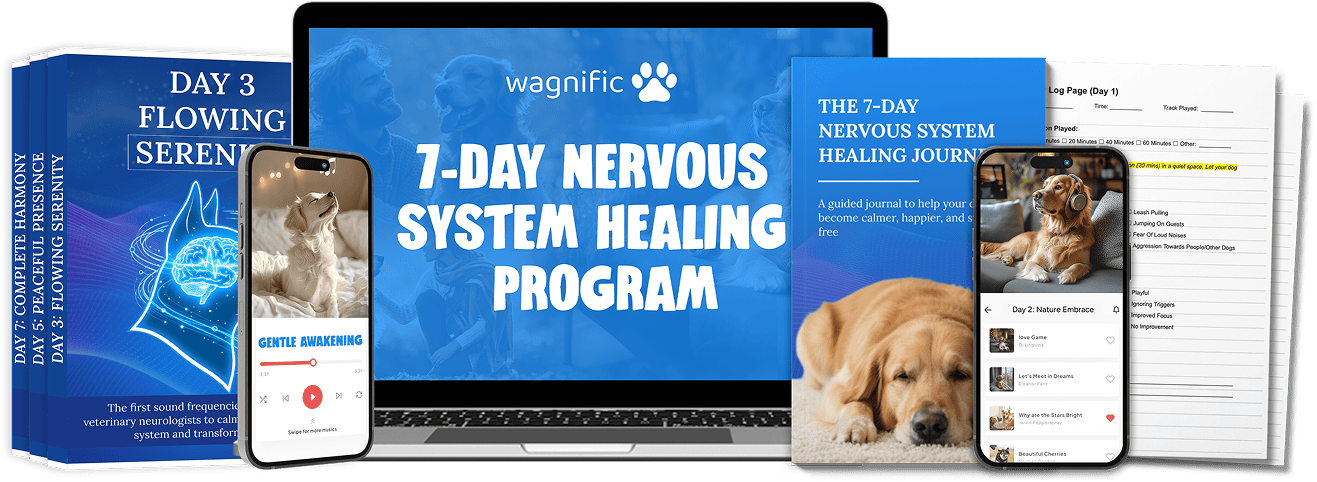
The result is Wagnific: the exact 7-day nervous system healing protocol used in Dr. Davies' clinic, calibrated for home use.
Introducing Wagnific: The 7-Day Nervous System Reset
Wagnific is NOT:
- Another training program that requires you to be a "dog whisperer"
- Generic "calming music" you could find on YouTube
- Medication that changes your dog's personality
- Something that takes months to work
Wagnific IS:
- Seven precisely calibrated 20-minute audio sessions (one per day)
- Based on 8 years of peer-reviewed canine neurology research
- The same protocol used in Dr. Davies' $1,750 clinical program
- Designed to work on any device: phone, tablet, laptop, smart speaker
- Accessible instantly via secure web portal (start in the next 2 minutes)
- Lifetime access with a progress tracking journal
Here's how it works:
1. Log in to your Wagnific portal (takes 30 seconds)
2. Press play on today's session
3. Let your dog listen for 20 minutes. That's it.
4. Watch the transformation unfold over 7 days
No training required. No commands. No treats. No special equipment.
Just press play and let the science do the work.
★★★★★
"I'm not exaggerating: I pressed play, went to make coffee, and came back to find my Chihuahua mix ASLEEP on the couch. She doesn't sleep during the day. She hasn't in 4 years. She's normally bouncing off the walls or barking at nothing. I had to take a picture because my husband wouldn't believe me."
Diane K., Chihuahua mix mom, Scottsdale, AZ
✓ Verified Buyer
The Results That Keep Me Up at Night (In a Good Way)
Since launching Wagnific to the public, 18,347 dog owners have completed the 7-day protocol.
Here are the numbers from our most recent survey:
94% reported a noticeable reduction in problem behaviors within 7 days
89% said their dog's leash pulling and reactivity on walks improved significantly
91% reported reduced or eliminated destructive behavior when left alone
86% said their dog started responding to commands more consistently
89% said they would recommend Wagnific to another dog owner

But the numbers don't tell the real story.
The real story is in the messages I get every single day from women who say some version of:
"I got my dog back."
That's what this is about. Not "fixing" your dog. Getting back the dog that's been hiding behind a wall of overstimulation, stress, and behaviors she can't control.
★★★★★
"I didn't even think of my dog as 'anxious.' I thought she was just badly behaved. Pulling, barking, chewing everything, ignoring me. Turns out it was all the same problem. One week in and it's like someone flipped a switch. She's calm. She listens. She actually LOOKS at me when I talk to her. I didn't know she could do that."
Sandra P., Husky mix mom, Nashville, TN
✓ Verified Buyer
The Price That Makes My Accountant Nervous
Let me put Wagnific's cost in context:
| Solution |
Cost |
| Private dog behaviorist (10 sessions) |
$1,500-$3,000 |
| Behavioral medication (annual) |
$600-$1,200 |
| Board-and-train program (2 weeks) |
$2,000-$5,000 |
| Dr. Davies' in-clinic protocol |
$1,750 |
| Wagnific (lifetime access) |
See below |
Wagnific's regular price is $69.
That's already a fraction of any alternative. And unlike medication, there are no refills. Unlike training, there are no follow-up sessions. You get lifetime access.
Because we want as many people as possible to experience the power of Wagnific, we're offering a special promotion on this page only.
Limited-Time Offer: 72% Off
⚠ Fewer Than 50 Spots Remaining
If you've been considering Wagnific, now is the moment to decide.
Dr. Davies' in-clinic treatment costs $1,750 for the full 7-day program.
Wagnific normally costs $69. Already a fraction of clinical treatment costs.
Right now, you can access the complete Wagnific program for just:
Regular: $69
$19
🔥 Less than 47 spots remaining at this price
CHECK IF SPOTS ARE STILL AVAILABLE →
Instant access • Works on any device • 30-day guarantee
🛡
My Personal 30-Day "Better Behaved Dog" Guarantee
I'm so confident in Wagnific that I'll take on 100% of the risk.
Try it for a full 30 days. Play the sessions. Track your dog's behavior.
If you don't see a meaningful improvement (less barking, less pulling, less destruction, better listening, a calmer dog) email [email protected] and I'll refund every penny. No questions. No hoops.
Why am I this confident? Because out of 18,347 customers, our refund rate is under 3%. And most of those were people who never actually played the sessions.
You have nothing to lose except your dog's worst behaviors.
You Have Two Paths From Here
Path 1: Keep Doing What You're Doing
- Keep spending $150/session on trainers who don't understand the root cause
- Keep refilling prescriptions that numb your dog instead of healing her
- Keep dreading walks, guests, and thunderstorms
- Keep apologizing for your dog's behavior
- Keep replacing destroyed shoes, cushions, and door frames
- Keep that knot in your stomach every time you leave the house
Path 2: Try Something That Actually Addresses the Root Cause
- Give your dog's nervous system the reset it's been begging for
- Watch the barking, pulling, destruction, and disobedience fade over 7 days
- Enjoy peaceful walks where your dog is present and responsive
- Leave the house without worrying about what you'll come home to
- Give a command and actually have your dog listen the first time
- Finally feel like the dog mom your dog deserves
The choice is yours. But if you've read this far, I think you already know which one feels right.
🔥 Less than 47 spots remaining at this price
CHECK IF SPOTS ARE STILL AVAILABLE →
Instant access • Works on any device • 30-day guarantee
Questions You Might Have
My dog's main problem is pulling on the leash and not listening. Is this really for her?
Yes. Leash pulling and ignoring commands are two of the most common symptoms of an overstimulated nervous system. Your dog isn't "choosing" to ignore you or drag you down the street. Her brain is in such a heightened state that she physically cannot process your commands or regulate her body. Once the nervous system settles, the pulling decreases and the listening clicks back on. It's one of the first things most owners notice.
Will this work for my dog's specific behavior issues?
Wagnific targets the underlying nervous system overstimulation that causes most behavior problems: excessive barking, reactivity, destruction, separation issues, leash pulling, hyperactivity, and inability to settle or follow commands. It has been tested across 14 breeds in our beta trial, from Chihuahuas to Great Danes. If your dog's issues stem from an overloaded nervous system (and the vast majority do), this protocol addresses the root cause.
How is this different from YouTube "dog calming music"?
Night and day. YouTube calming music uses pleasant sounds that might provide temporary distraction. Wagnific uses specific sound frequencies developed through 8 years of canine brain research to trigger three calming responses in your dog's nervous system at the same time. It's the difference between taking an aspirin and treating the infection. One masks the symptom, the other addresses the cause.
My dog is already on medication. Can I still use this?
Yes. As a veterinarian, I specifically designed Wagnific to be safe alongside medication. Many of our members use Wagnific while working with their vet to gradually reduce medication over time, but always do this with your vet's guidance. Wagnific is audio, not medicine. It won't interfere with anything your dog is currently taking.
Do I need special speakers or equipment?
No. Any device that plays audio works: your phone, a tablet, a laptop, a smart speaker, even a TV. For best results, we recommend playing it at a comfortable volume in the room where your dog spends the most time. No headphones required (obviously... they're dogs).
How quickly will I see results?
Most owners notice small changes within the first 1-2 sessions: calmer breathing, less panting, a brief period of settling. Significant behavioral changes typically emerge between days 4-7. The full nervous system reset continues to deepen over the following weeks with continued use. Some dogs respond faster, some slower, which is exactly why we offer a 30-day guarantee instead of a 7-day one.
Ready to Meet the Dog That's Been Hiding Behind All That Chaos?
Your dog isn't broken.
She isn't "bad." She isn't "stubborn." She isn't beyond help.
Her nervous system is stuck in a mode it was never meant to stay in. And every day it stays there, the patterns get deeper and harder to reverse.
20 minutes a day. 7 days. $19.
That's all it takes to find out if this is the answer you've been searching for.
And if it's not? You get every penny back. No questions asked.
🔥 Less than 47 spots remaining at this price
CHECK IF SPOTS ARE STILL AVAILABLE →
Instant access • 30-day money-back guarantee • 18,347 happy dog owners and counting
With love (and a calm, sleeping golden retriever at my feet),
Dr. Jessica Clarke, DVM
Veterinary Behaviorist & Founder of Wagnific

P.S. Last night, Lucy and I went for an evening walk. No leash pulling. No barking at the neighbor's cat. No lunging at the dog across the street. Just the two of us, walking in the kind of peaceful quiet I used to think was impossible. Three years ago, I was googling "rehoming a difficult dog." Today, I can't imagine my life without her. Your dog's version of this story is 7 days away.
P.P.S. The $19 price is only available while spots remain. Due to licensing requirements, we can only offer this rate to a limited number of new members. Once capacity is reached, enrollment closes and the price returns to $69. If the button below still works, spots are still open. I can't guarantee how long that will be.
🔥 Less than 47 spots remaining at this price
CHECK IF SPOTS ARE STILL AVAILABLE →

Penny: noticed less destruction by Day 3. By Day 7 she stopped pacing at night AND stopped pulling on walks. She used to drag me down the street. Now she actually walks beside me.
Bear: Took longer. Didn't notice much until Day 5-6. But by the end of week 2, his barking and reactivity on walks dropped dramatically. He used to lunge at every dog. Now he can walk past most dogs with just a look. He also started responding to commands again.
It's not perfect. Bear still reacts to off-leash dogs that run at us (honestly who doesn't lol). But the improvement is huge. Worth every penny. No pun intended 😂